Timing Guide • 2026
Best Time to Visit Upper Antelope Canyon: Light Beams, Tour Times & Monsoon Season
For a first visit to Upper Antelope Canyon, May and June offer the best overall balance. Light-beam season is underway, while the more active northern Arizona monsoon pattern usually does not arrive until around early July. If the most dramatic beams are your priority, aim close to midsummer; April and September are milder alternatives that can still produce beams.
Upper Antelope Canyon can only be visited on a guided tour, so when you book you are choosing both the date and the entry time. This guide compares the months and tour times, explains the summer monsoon risk, and lets you check the sun angle, cloud forecast and weather alerts for your day.
Upper Antelope Canyon can be visited year-round, but only on a guided tour. Navajo Nation Parks closes the area for Thanksgiving, Navajo Nation Family Day (the day after Thanksgiving), Christmas Day and New Year's Day. The biggest seasonal difference is the light: the famous beams appear mainly from April through September, when the midday sun is high enough to shine directly into the canyon on clear days.
If your dates are flexible, May and June are the best overall months for a first visit. May is cooler; June has the highest sun angle and is typically very dry, although it is also hotter. Popular midday tours can sell out well ahead, so book early.
For the beams, choose a tour around midday, roughly 11 a.m. to 1 p.m. Arizona time, depending on the operator and date. Earlier and later tours are less likely to show the famous shafts, but the softer reflected light can bring out deeper orange and red tones in the canyon walls.
July through September remains good for beams, but it also overlaps with Arizona's monsoon season. The official season runs from June 15 to September 30, but in northern Arizona the afternoon and evening thunderstorms usually start around early July. They can lead to closures because of flash-flood risk, including when the heavy rain falls upstream rather than over the canyon itself. Check National Weather Service thunderstorm and flash-flood alerts on the day of your tour.
By October the classic beams become much less reliable. From late October to early March, visit for the rich reflected color, sculpted sandstone and cooler temperatures rather than expecting the vertical shafts. Winter is also a quieter period in Page, although December and January are cold.
From $115 per person on GetYourGuide · or pick a tour time in the calendar below
What you wantBest time
- Getting in
- Only on a Navajo-guided tour
- Best overall for a first visit
- May–June; June hotter, Page busier
- Strongest light beams
- Late spring to midsummer
- Tour time for beams
- Around 11 a.m.–1 p.m., depending on operator
- Softer, reflected light
- Earlier or later tours
- First thin beams of the year
- Mid- to late March
- Milder than midsummer, beams still possible
- April or September, but smaller in early April and late September
- Monsoon storms most likely
- July–September, mostly afternoons
- Quieter in Page, no reliable beams
- November–February, but cold in midwinter
- Most useful checks on the day
- Cloud cover · thunderstorms/flash-flood alerts · temperature
- Roughly April to SeptemberLight-beam season published by Upper Antelope operators; one runs mid-March to mid-September
- 77° / 30°Midday sun at the canyon in late June / late December: high enough for beams in summer, too low in winter
- 94°F / 98°FAverage June / July high at Page, felt outside the shaded canyon
How the light beams work
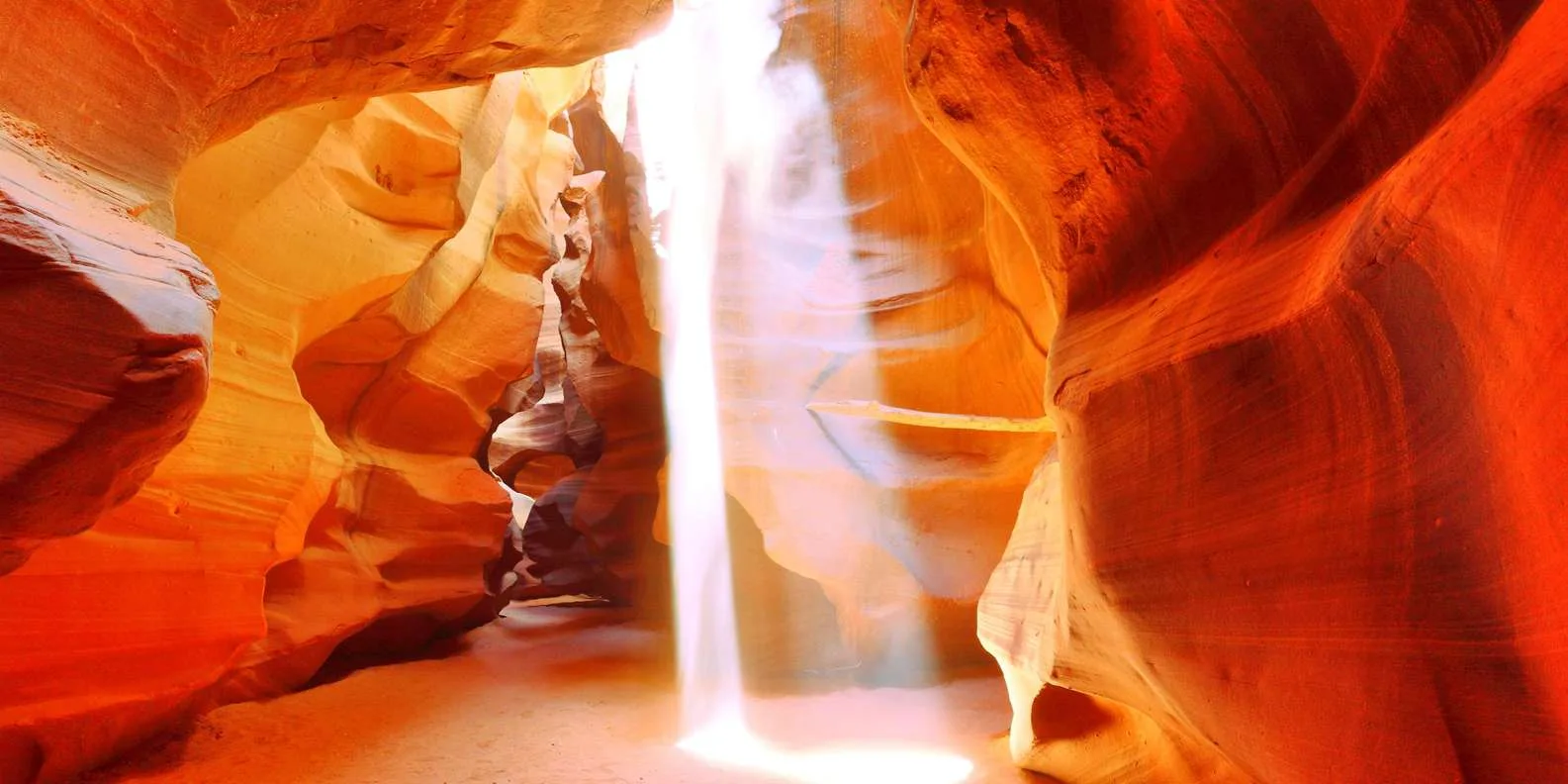
Upper Antelope Canyon is narrow at the top and wider at the floor, so from inside you see only a thin strip of sky. When the sun is high enough, its light drops straight through that opening and lands on the sand as a bright shaft. Guides often toss a handful of sand into the light so the shaft shows up in photos.
Three things have to line up for a beam:
- The time of year. At the canyon the midday sun reaches 77° above the horizon around June 21 and only 30° around December 21. Operators publish the beam season as April to September, and one, Tsé Bíghanílíní Tours, starts it in mid-March.
- The tour time. The sun is highest shortly after noon Arizona time, so the beams appear on the tours around the middle of the day. The date checker below gives the exact time for your date.
- A clear sky. A beam is direct sunlight, so heavy cloud removes it, even in June.
The walk itself is the same in every month. You follow a Navajo guide through the canyon on flat sand for roughly 30 to 50 minutes, depending on the operator, and several operators then bring you back over the top on outdoor stairs. Tripods are not allowed, and the last dedicated photography tours of Upper Antelope ran in 2019, so there is no separate photographer's tour to plan around.
Other experiences you might enjoy near Page
A midday tour leaves the rest of the day free for other stops around Page. The overlook at Horseshoe Bend is about 5 miles south of town, Lake Powell has boat trips into the water-filled lower end of Antelope Canyon, and Lower Antelope Canyon, entered by steep stairs and ladders, fits before or after an Upper tour. Day trips from Las Vegas and Sedona combine several of these stops. Live availability for tours around Page is below.
Check your date
Pick a date to see how high the sun gets over the canyon, when it is highest, and the temperature and rain at Page. Within about 16 days of today the card uses the forecast, including cloud and thunderstorms over the tour hours; further ahead it shows long-term averages. For today and tomorrow it also lists any National Weather Service alerts for the canyon area.
Showing the general pattern through the year. Pick a date to see the sun angle for that day and the weather at Page.
- Beams are possible from about April to September, when the midday sun is high enough
- For beams, choose a tour around midday, roughly 11 a.m. to 1 p.m.
- Heavy cloud removes the beams, even in summer
- From June 15 to September 30, thunderstorms can close the canyon because of flash-flood risk
- Entry is only on a Navajo-guided tour, so book a tour time before you travel
Pick a date and this line says whether it suits the light beams, and which tour time to choose.
Check tour times for this dateThe sun angle is calculated for the canyon and holds for any year. The weather is a forecast or a long-term average, not a promise, and an alert can be issued on the day with little notice. None of it tells you whether a tour time still has space; the availability calendar above shows that.
Monsoon season and flash floods
The National Weather Service defines Arizona's monsoon season as June 15 to September 30. For northern Arizona, its Flagstaff office says the monsoon moisture "typically does not reach the region until the first week of July", that it then brings "afternoon and evening thunderstorms" on most days, and that the season usually starts to wind down in September.
In a slot canyon, a storm is a safety risk. During monsoon season, storms elsewhere in the drainage can create flash-flood danger at Antelope Canyon even when conditions near Page look relatively clear. On September 13, 2026, for example, the NWS office in Flagstaff issued a flash flood warning for Antelope Canyon at 2:14 p.m., after radar showed thunderstorms producing heavy rain nearby. One operator, Antelope Slot Canyon Tours, also puts the risk in proportion:
"Our peak monsoon season runs from July through September, though actual canyon flooding is rare."
Tour operators and Navajo Nation Parks decide closures for weather and safety. When an operator cancels, you get your money back: Antelope Canyon Tours gives a full refund, Adventurous Antelope Canyon Tours a 100% refund, and Tsé Bíghanílíní Tours an alternative arrangement or a refund. A new tour time is a separate booking and depends on what is still free.
Cloud is treated differently. A cloudy day that hides the beams is not a cancellation, and Antelope Canyon Tours says it does not accept same-day cancellations for cloud, because it "cannot guarantee sunshine".
From July to September, storms are most common in the afternoon and evening, so on a day with storms in the forecast, a morning or late-morning tour is less likely to be caught by them. On the day, check the National Weather Service Flagstaff forecast for thunderstorms and flash-flood alerts. If you are spending several days around Page, schedule the canyon early in your stay, so that a tour cancelled for weather leaves you more days to find another, although a later tour may already be full.
Month by month
The midday sun below is calculated for the canyon on the 15th of each month. Temperature and rainfall are 30-year averages for Page, about 5 miles away, so they describe the town and the parts of the tour outside the canyon. The last column shows how busy the Page area is against an average month, explained under the table.
| Month | Midday sun | Light beams | Average high at Page | Average rain at Page | Page-area visitor index |
|---|---|---|---|---|---|
| January | 32° | No | 46°F | 0.57 in | 30 |
| February | 41° | No | 53°F | 0.56 in | 53 |
| March | 51° | Thin, late in the month | 63°F | 0.48 in | 107 |
| April | 63° | Yes, smaller early in the month | 72°F | 0.36 in | 130 |
| May | 72° | Strong | 82°F | 0.41 in | 139 |
| June | 76° | Strong | 94°F | 0.12 in | 170 |
| July | 75° | Strong; monsoon storms | 98°F | 0.55 in | 155 |
| August | 67° | Strong; monsoon storms | 95°F | 0.75 in | 128 |
| September | 56° | Yes, shorter late in the month | 87°F | 0.67 in | 109 |
| October | 44° | Much less reliable; smaller if any | 72°F | 0.82 in | 89 |
| November | 35° | No | 57°F | 0.41 in | 54 |
| December | 30° | No | 45°F | 0.43 in | 36 |
The visitor index sets an average month at 100, so June at 170 has about 70% more visits than average and January at 30 fewer than a third. It is built from National Park Service recreation visits to Glen Canyon National Recreation Area, which surrounds Page and Lake Powell, averaged over 2023 to 2025. It shows how busy the town, the roads and the hotels are. It does not count people on canyon tours, which are on Navajo Nation land and are not published.
March and April
Beams start to reach the floor in the second half of March and grow through April, although they are still smaller at the start of the month. April is the mildest of the main beam months, averaging 72°F at Page, and at 0.36 in of rain it is the driest spring month. The Page area is already busier than an average month from March onward.
May and June
In May the midday sun reaches 70° and the beams are strong, with average highs of 82°F at Page. June has the year's highest sun around June 21 and the least rain, 0.12 in on average, but it is also the busiest month in the Page area and averages 94°F. The monsoon season officially starts on June 15, but the National Weather Service says its moisture usually reaches northern Arizona only in the first week of July.
July and August
Beams stay strong through July and most of August, but monsoon thunderstorms are common from July into September. They usually build in the afternoon and evening, and a storm upstream can send water through the canyon, so closures are possible at short notice. July is the hottest month at Page, averaging 98°F.
September and October
September is still part of the beam season, and the monsoon usually winds down during the month. Toward the end of September the shafts become shorter and less reliable, and by October the classic beams become much less reliable: the midday sun falls below about 48° in the first week of the month, and any beams that appear later in October are smaller and do not last as long. October is as mild as April at Page, averaging 72°F, but its midday sun is as low as late February's, which is why the beams fade while the weather is still comfortable. It is also the wettest month at Page on average, at 0.82 in.
November to February
There are no reliable vertical beams in these months. The sun lights the top of the walls, and softer reflected light brings out color on the sandstone lower down. The Page area is at its quietest in December and January, some operators offer discounts in late fall and winter, and average highs at Page run from 45°F to 57°F. Navajo Nation Parks closes the canyon on Thanksgiving, the day after, Christmas Day and New Year's Day, and at least one operator runs its late-afternoon tour only from April 1 to September 30.
Best time of day
The tour time matters as much as the month, and it is the part you can still choose once your trip dates are fixed. For light beams, choose a tour around midday, roughly 11 a.m. to 1 p.m. Arizona time, depending on the operator and your date. Schedules differ between operators and change from season to season. When we checked on September 23, 2026, for example:
- Antelope Canyon Tours said its 11:20 a.m. tour gives "a chance to see some beams of light".
- Adventurous Antelope Canyon Tours said its 10:45 a.m. tour "offers the best lighting".
- Tsé Bíghanílíní Tours labeled its 11:05 a.m. and 1:25 p.m. tours "Best Lighting".
The date checker above gives the time the sun is highest on your date, which is when the beams are strongest.
In winter there are no classic beams, but midday still brings the most light into the canyon. Adventurous Antelope Canyon Tours, for example, says that from November 1 through March 31 its 3:15 p.m. tour is darker, and that its 11:05 a.m. and 1:10 p.m. tours are "ideal times for full sunlight".
Earlier and later tours are less likely to show the famous shafts, but the indirect light can bring out deeper orange and red on the walls, and operators describe different times of day as producing different colors. Those tours can also cost less: Antelope Canyon Navajo Tours charges $120 for its midday tour and $100 for its other times, both including the $15 Navajo permit, and Antelope Canyon Tours prices its midday tour higher than its others.
Crowds, prices and booking ahead
The canyon is narrow, so how busy it feels depends on your tour time as much as your month. Nobody publishes visitor numbers for the canyon, so the best measure available is National Park Service visits to Glen Canyon National Recreation Area around Page. By that measure, June has about 70% more visits than an average month, April about 30% more, and December and January about a third of an average month or less. Much of the summer peak is Lake Powell traffic, so treat it as a guide to how busy the town and its hotels are.
Two things you can plan around change with the season:
- How far ahead to book. Popular midday tours can sell out well in advance from late spring through summer, so book them early. Demand around Page is lower in winter, although holiday weeks can still fill.
- The price. Some operators vary their rates by season: Antelope Canyon Tours, for example, says discounts are available in late fall and winter. On GetYourGuide, the Upper Antelope Canyon Entry Ticket and Guided Tour starts from $115 per person.
Navajo Nation Parks limits visits inside Upper Antelope Canyon to two hours and charges an entry fee of $15 per person, per location, per day. Some operators include it in their price and some add it at checkout. The full breakdown is in our tickets, prices and permits guide.
Heat, cold and the walk back
Inside the canyon you walk in shade, so the heat you feel is mostly outside it: at check-in, on the ride out and, at several operators, on the walk back over the top. Adventurous Antelope Canyon Tours counts 21 steps up and 112 down on that return, and Antelope Canyon Navajo Tours says 150 stairs. In June, July and August, when Page averages 94°F to 98°F, bring water and a hat, and check your operator's bag rules before you go: some allow only clear bags, and Adventurous allows no bags at all.
From December to February, average highs at Page are only 45°F to 53°F, and mornings are colder. Dress for the ride and the walk outside the canyon, and wear closed shoes in every season for the sand.
Choose by what you came for
For the light beams
May or June, on a tour around midday, roughly 11 a.m. to 1 p.m. The midday sun stays above 65° through both months, and the more active monsoon pattern usually does not arrive until around early July. Book early, because popular midday times can sell out well in advance.
Check midday tour timesFor milder weather, with beams still possible
April or September. Average highs at Page are 72°F in April and 87°F in September, against 94°F in June. Both can still produce light beams, but the midday sun is lower than around midsummer, especially in early April and late September.
Check tour datesFor a quieter visit
November to February, when the Page area is at its quietest and some operators discount tours. Visit for the canyon's reflected color and sculpted sandstone rather than expecting the classic beams.
Check winter tour timesIf you are still choosing dates for a wider trip around Page, Horseshoe Bend and Lake Powell, April and May or September and October are more comfortable for time outdoors than midsummer: average highs at Page run from 72°F to 87°F in those months, against 94°F to 98°F in June and July. You can browse tours around Page on GetYourGuide, compare the two canyons in our Upper vs Lower Antelope Canyon guide, or plan the drive with our guide to visiting from Las Vegas.
Sources and methodology
How we checked the figures on this page
- Sun angles and the time the sun is highest are calculated for Upper Antelope Canyon (36.86° N, 111.37° W) on Arizona time, using standard solar position formulas. The month table uses the 15th of each month.
- Temperature and rainfall are NOAA National Centers for Environmental Information 1991–2020 monthly normals for Page Municipal Airport, station USW00003162.
- The visitor index is the 2023–2025 average of National Park Service monthly recreation visits to Glen Canyon National Recreation Area, set so that an average month is 100.
- Monsoon dates, storm timing and the September 13, 2026 flash flood warning come from the National Weather Service office in Flagstaff; the warning text was read from the Iowa Environmental Mesonet archive of NWS products.
- Beam seasons, tour times, prices and weather policies come from the published pages of Antelope Canyon Tours, Antelope Slot Canyon Tours, Tsé Bíghanílíní Tours, Antelope Canyon Navajo Tours and Adventurous Antelope Canyon Tours. Holiday closures, the entry fee and the two-hour limit come from Navajo Nation Parks & Recreation. All were checked on September 23, 2026.
- The GetYourGuide rating and review count were read from the tour listing on September 23, 2026; the price is the starting price this site publishes for that tour.
What these numbers cannot tell you
- The visitor index is a stand-in. It counts visits to a recreation area dominated by Lake Powell, not people on canyon tours, which nobody publishes.
- Temperature and rainfall are 30-year averages for the town, not a forecast, and an average high does not rule out a hotter day. Monthly rainfall is a total for the month; it does not say how many days are wet.
- Operators publish slightly different beam seasons, from April to September at most to mid-March to mid-September at one. The beam season is a pattern, not a guarantee for a given day.
- No operator we checked publishes its own holiday closures. We use the Navajo Nation Parks list, and one operator says it is open every day of the year, so confirm with yours if your date is a holiday.
- Tour times and prices change, and operators run different schedules, so the 11 a.m. to 1 p.m. beam window on this page is a rounded range. Confirm both when you book.
- We have no live feed of which tour times still have space. The availability calendar on this page shows that.
FAQ
Best time to visit Upper Antelope Canyon: your questions answered
What is the best time to see the light beams in Upper Antelope Canyon?
On a clear day from about April through September, on a tour around midday, roughly 11 a.m. to 1 p.m. Arizona time, depending on the operator and your date. The beams are strongest from late spring into summer, when the midday sun is highest.
What is the best month to visit Upper Antelope Canyon?
For a first visit, May or June. Light-beam season is underway, and the more active northern Arizona monsoon pattern usually does not arrive until around early July. May is cooler; June has the highest sun angle and is typically very dry, but it is also hotter and Page is busier. April and September are milder than midsummer and can still produce beams, although the midday sun is lower.
What is the best time of day to visit Upper Antelope Canyon?
For the light beams, a tour around midday, roughly 11 a.m. to 1 p.m. Arizona time, depending on the operator and your date. Earlier and later tours are less likely to show the beams, but the softer reflected light can bring out deeper orange and red on the walls, and at some operators those tours cost less.
What is the best time of day to visit Upper Antelope Canyon in winter?
A tour around the middle of the day. The classic beams are much less reliable from October and rare from late October to early March, but midday still brings the most light into the canyon. Adventurous Antelope Canyon Tours, for example, says that from November 1 through March 31 its 3:15 p.m. tour is darker, and that its 11:05 a.m. and 1:10 p.m. tours are the ideal times for full sunlight.
Can you see light beams in Upper Antelope Canyon in winter?
Not reliably. By October the classic beams become much less reliable, and from late October to early March the midday sun is too low for direct light to reach the canyon floor on most days. Sunlight still catches the upper walls, and softer reflected light brings out color on the sandstone lower down.
Are there light beams in Upper Antelope Canyon in October?
Sometimes, but they are much less reliable than in summer. Operators publish their beam seasons as ending in September, although Antelope Canyon Tours says beams can still appear, smaller and shorter-lived, toward the end of October. October is still mild at Page, averaging 72°F, so plan it as a visit for the walls and their color, with any beams as a bonus.
Is it safe to visit Upper Antelope Canyon during monsoon season?
Yes, if you follow closures and check the forecast. The monsoon season runs from June 15 to September 30, storms usually reach northern Arizona in the first week of July, and they are most common in the afternoon and evening. A thunderstorm upstream can flood the canyon even when the sky over Page looks clear, so operators and Navajo Nation Parks close it when there is a risk, and operators refund the tours they cancel.
Which months are quieter at Upper Antelope Canyon?
November to February. In December and January the Page area has about a third of an average month's visits, based on National Park Service figures for Glen Canyon National Recreation Area. Nobody publishes visitor numbers for the canyon itself, and tours are still available through the winter.
Do you need a midday tour to enjoy Upper Antelope Canyon?
Only for the light beams. Earlier and later tours show the walls in softer light, and at operators that charge more for the midday time they cost less. At Antelope Canyon Navajo Tours, for example, the midday tour is $120 and the other times are $100, both including the Navajo permit.
Is Upper Antelope Canyon open on holidays?
Navajo Nation Parks lists four closure days for the tribal park: Thanksgiving Day, Navajo Nation Family Day (the day after Thanksgiving), Christmas Day and New Year's Day. If your trip falls on one of those dates, confirm with your tour operator before you book.
Can you visit Upper Antelope Canyon without a tour?
No. Upper Antelope Canyon is on Navajo Nation land and you can enter only on a tour with an authorized Navajo guide, so choosing your date also means booking a tour time.
What time zone do Upper Antelope Canyon tours use?
Arizona time, which is Mountain Standard Time all year, the same as Page and Phoenix. The surrounding Navajo Nation observes daylight saving time from March to November, so a phone that switches networks near the canyon can show a time one hour ahead. Go by the time on your booking.